Abstract
Single Image Reflection Removal (SIRR) seeks to recover the transmitted scene from a photograph captured through glass. Recent latent restoration methods use pretrained generative priors, but many recover detail by feeding high-frequency features from the degraded input back into the decoder. This works for degradations such as blur, noise, or haze, where input detail mostly belongs to the scene. It is less suitable for SIRR, where reflections add a second structured layer: directly reusing the input's skip connections can sharpen the image while also bringing reflection edges back. Latent compression also introduces color drift and fine-detail loss.
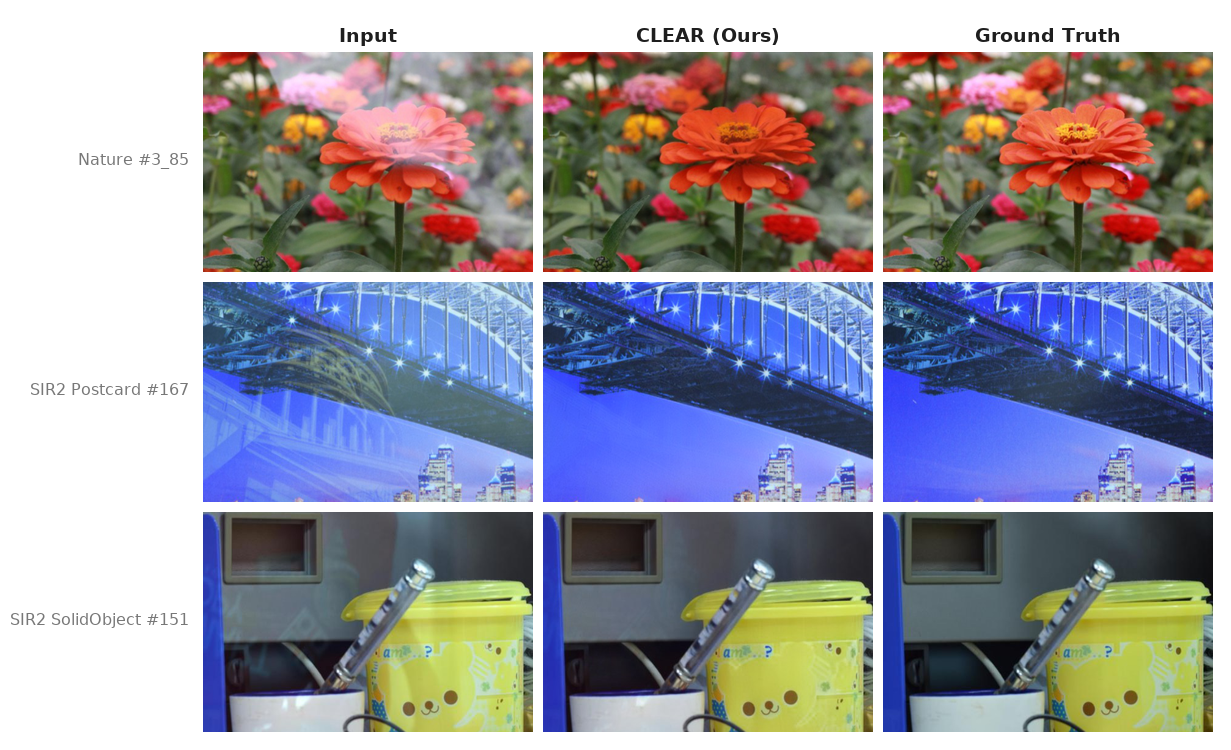
We propose CLEAR (Color-Texture LatEnt Alignment for Single Image Reflection Removal), a deterministic, single-timestep, non-iterative latent framework that uses a pretrained latent diffusion backbone as a natural-image prior. A physics-guided separator organizes the prediction around the transmission, reflection, and residue formation model and outputs coarse layer latents in one forward pass. The Hybrid Feature Alignment Module (HFAM) then treats input-derived skips as contaminated layer-mixture features. It rectifies their high-frequency content with a clean-transmission-aligned color query, learned from the input features themselves under ground-truth feature supervision, keeping transmission-consistent texture while attenuating reflection-colored detail. CLEAR achieves the best average across fidelity and perceptual metrics on six real-world benchmarks and the lowest LPIPS on every dataset, with the largest gains on the hardest benchmarks.
Method
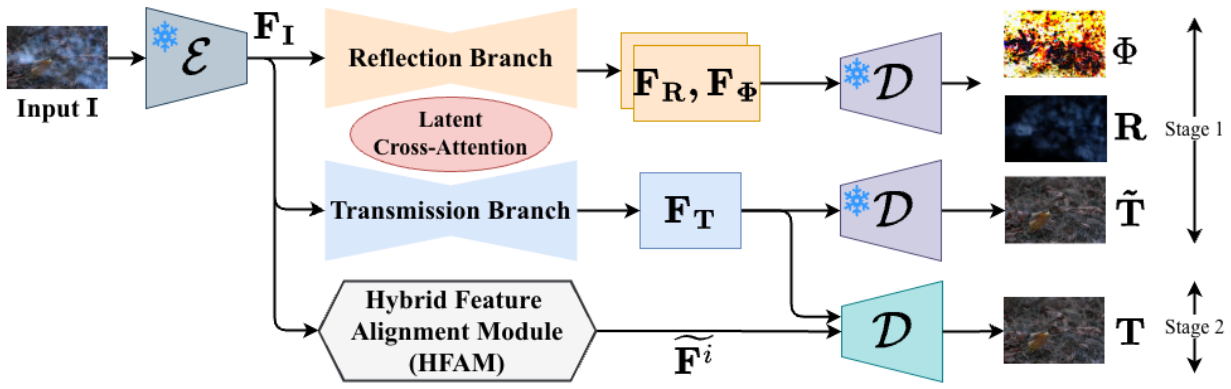
CLEAR is a two-stage pipeline: a dual-branch latent separator (Stage 1) and a cross-latent decoder augmented with the Hybrid Feature Alignment Module (Stage 2). Both stages run in a single deterministic forward pass — no sampling, no noise schedule.
Stage 1 — Physics-guided latent separator
The image formation model I = T + R (+ residue Φ) organizes the prediction. Two SDv2-initialized U-Net branches exchange information through latent cross-attention and output the transmission, reflection, and residue latents in one forward pass. The VAE encoder stays frozen, so both branches share the same latent manifold and the same natural-image prior.
Stage 2 — HFAM decoder refinement
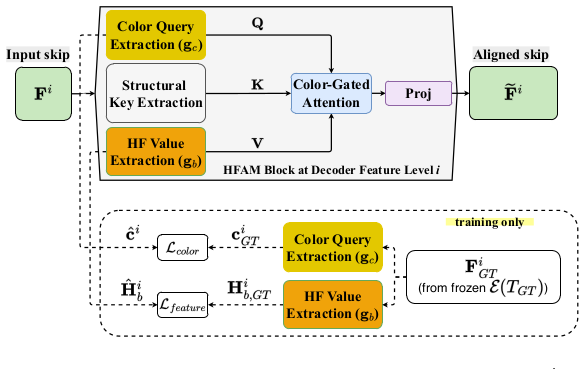
Stage 1 separates layers structurally but leaves blurred texture and color drift. The decoder needs a high-frequency source, and the input is the only adequate one — but the input skips are contaminated layer-mixture features. HFAM turns skip injection into an alignment problem.
- Deterministic. Single timestep, non-iterative, no random sampling — the output is reproducible run to run.
- Color-gated channel attention. Affinity is computed across channels (Q̂K̂⊤ ∈ ℝC×C), so cost is linear in the number of pixels.
- Clean-transmission supervision. The color query and high-frequency heads are supervised with features of the clean transmission extracted by the same frozen encoder — the targets never touch the decoded output.
- Physically grounded. The learned residue Φ absorbs non-linear effects such as saturation, where the linear model I = T + R is violated.
Results
We evaluate on six real-world benchmarks — Nature, SIR2, Real20, DRR-C, DRR-S, and OpenRR-1k — against RobustSIRR, RRW, DSIT, DSRNet, RDNet, DAI, and WindowSeat. Following the adaptation protocol of DAI, every method is fine-tuned on identical training data and evaluated with the same scripts, so the comparison isolates architectural and methodological differences rather than training-data advantages.
Qualitative comparison
Every tile pairs the input (left) with the method's result (right). Click a tile to load it into the slider above, double-click for a full-size comparison, or use ← / → to step through the methods.
Drag the handle to wipe between the input and the selected result.
Quantitative comparison
↑ higher is better, ↓ lower is better. Bold = best, underlined = second best. Averaged over all six benchmarks (1,040 images), CLEAR is best on every metric and has the lowest LPIPS on every individual dataset.
| Dataset | Metric | RobustSIRR | RRW | DSIT | DSRNet | RDNet | DAI | WindowSeat | CLEAR (Ours) |
|---|
| Method | PSNR ↑ | SSIM ↑ | LPIPS ↓ | MANIQA ↑ | QUALICLIP ↑ |
|---|---|---|---|---|---|
| RobustSIRR | 21.14 | 0.791 | 0.221 | 0.479 | 0.704 |
| RRW | 23.43 | 0.815 | 0.202 | 0.458 | 0.689 |
| DSIT | 23.99 | 0.817 | 0.198 | 0.479 | 0.706 |
| DSRNet | 21.42 | 0.809 | 0.201 | 0.485 | 0.714 |
| RDNet | 23.92 | 0.822 | 0.192 | 0.486 | 0.707 |
| DAI | 25.98 | 0.869 | 0.159 | 0.460 | 0.696 |
| WindowSeat | 25.48 | 0.810 | 0.208 | 0.465 | 0.674 |
| CLEAR (Ours) | 26.59 | 0.906 | 0.106 | 0.504 | 0.731 |
Average over Nature, SIR2, Real20, DRR-C, DRR-S and OpenRR-1k (1,040 images).
Ablations & analysis
Stage 2, residue, and HFAM sub-paths
| S2 | Φ | HF | Color | Nature | Real20 | SIR2 | |||
|---|---|---|---|---|---|---|---|---|---|
| PSNR ↑ | SSIM ↑ | PSNR ↑ | SSIM ↑ | PSNR ↑ | SSIM ↑ | ||||
| ✗ | ✗ | ✗ | ✗ | 25.09 | 0.838 | 23.52 | 0.779 | 26.34 | 0.904 |
| ✓ | ✗ | ✗ | ✗ | 25.32 | 0.847 | 23.52 | 0.819 | 26.41 | 0.932 |
| ✓ | ✓ | ✗ | ✗ | 26.02 | 0.865 | 23.60 | 0.824 | 26.57 | 0.933 |
| ✓ | ✓ | ✗ | ✓ | 26.15 | 0.869 | 23.52 | 0.823 | 26.65 | 0.934 |
| ✓ | ✓ | ✓ | ✗ | 26.04 | 0.868 | 23.73 | 0.823 | 26.69 | 0.932 |
| ✓ | ✓ | ✓ | ✓ | 26.45 | 0.867 | 23.74 | 0.824 | 27.71 | 0.934 |
The color and high-frequency paths are complementary: alone each improves PSNR, together they are best. The full model also reduces ΔE00 by 4.2% over the Stage-2+Φ baseline on SIR2 (4.983 → 4.774) and cuts reflection leakage (corr.) from 0.2657 to 0.2243 (−15.6%, paired bootstrap, 10k resamples).
Capacity vs. methodology
| Method | Total | Trainable | Time (s) ↓ | PSNR ↑ | SSIM ↑ | LPIPS ↓ |
|---|---|---|---|---|---|---|
| DAI | 1.74B | 0.95B | 0.40 | 25.98 | 0.869 | 0.159 |
| GenSIRR † | 12.11B | 12.02B | 53.8 | 26.47 | 0.879 | 0.130 |
| CLEAR (BK-SDM-Small) | 1.29B | 1.08B | 0.42 | 26.24 | 0.908 | 0.117 |
| CLEAR (SDv2) | 2.27B | 1.84B | 0.56 | 26.59 | 0.906 | 0.106 |
| CLEAR (generic S2 refiner) ‡ | 2.27B | 1.84B | 0.57 | 25.80 | 0.861 | 0.152 |
| CLEAR (half-size HFAM) ‡ | 2.27B | 1.82B | 0.54 | 26.25 | 0.903 | 0.108 |
Averaged over all benchmarks; time on one A6000. † GenSIRR is concurrent and uses its native 1MP setting. ‡ A generic Stage-2 refiner matched to HFAM's parameters and FLOPs, and a half-size HFAM, both trained under identical schedules. The gains come from the method, not from scale.
How detail enters Stage 2
| Detail injection (same Stage 1 output) | PSNR ↑ | SSIM ↑ | LPIPS ↓ |
|---|---|---|---|
| Stage 1 only (no Stage 2) | 25.96 | 0.891 | 0.115 |
| Stage 1 + copy input skips | 26.21 | 0.896 | 0.112 |
| Stage 1 + Wavelet fix | 22.54 | 0.825 | 0.160 |
| Stage 1 + AdaIN fix | 23.42 | 0.825 | 0.158 |
| Stage 1 + HFAM (ours) | 26.59 | 0.906 | 0.106 |
Copying the input skips recovers sharpness but reintroduces the reflection; global color fixes fall below the no-refinement baseline. HFAM is best on all three metrics.
Citation
If you use this work, please cite:
@inproceedings{vo2027clear,
  title     = {CLEAR: Color-Texture Latent Alignment for Single Image Reflection Removal},
  author    = {Vo, Tu and Zaheer, Sheir A. and Park, Chan Y.},
  booktitle = {The IEEE/CVF Winter Conference on Applications of Computer Vision (WACV)},
  year      = {2027}
}